
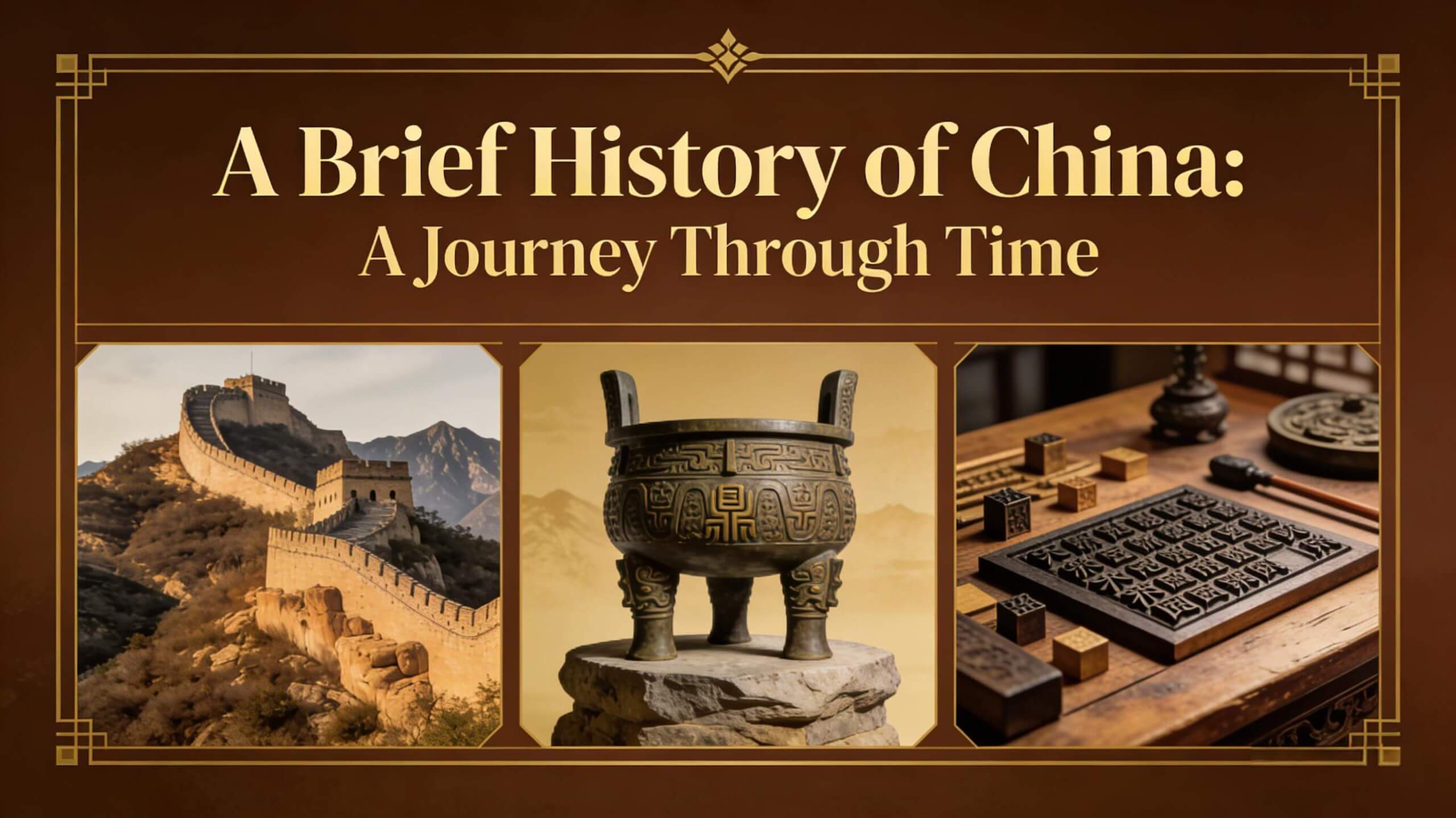
A Brief History of China: A Journey Through Time
China is one of the world’s oldest continuous civilizations, with a history spanning over 5,000 years. Unlike many ancient cultures that faded away, Chinese civilization has preserved its unique identity, traditions, and written language through millennia. This article offers a clear, concise overview of China’s key eras, paired with comparisons to major contemporary civilizations and dynasties around the world—helping global readers contextualize China’s place in human history. (Sources: Cambridge History of China, Harvard-Yenching Institute)
Ancient Foundations (c. 3000 BCE – 221 BCE)
This era laid the groundwork for Chinese civilization, from early settlements to the birth of core philosophical ideas.
Key Developments
- Neolithic Age (c. 3000 BCE – 2070 BCE): The Yangshao and Liangzhu cultures flourished, known for exquisite pottery and advanced urban planning (Liangzhu’s water management system was unparalleled globally at the time). (Source: Chinese Academy of Social Sciences, Archaeology Institute)
- Xia Dynasty (c. 2070 BCE – 1600 BCE): China’s first legendary dynasty, marking the transition from primitive society to a slave-based state. (Source: Records of the Grand Historian, Sima Qian)
- Shang Dynasty (c. 1600 BCE – 1046 BCE): The first dynasty with confirmed written records (oracle bone inscriptions), and masterful bronze smelting technology. (Source: Institute of History, Chinese Academy of Social Sciences)
- Zhou Dynasty (1046 BCE – 221 BCE): Divided into Western and Eastern Zhou, it saw the rise of Confucianism (Confucius) and Taoism (Laozi)—two schools of thought that shaped Chinese culture forever. The Eastern Zhou period (Spring and Autumn/Warring States) was an era of intellectual flourishing, often called China’s “Axial Age.” (Sources: Analects, Tao Te Ching; Cambridge History of Ancient China)
Global Comparison
| Chinese Period | Contemporary Global Civilizations |
|---|---|
| Liangzhu Culture (c. 3000 BCE) | Ancient Egypt (Early Dynastic Period, building the first pyramids); Mesopotamia (Sumerian city-states, cuneiform writing) (Source: Oxford History of Ancient Egypt) |
| Shang Dynasty (c. 1600 BCE) | Ancient Egypt (New Kingdom, reign of Tutankhamun); Hittite Empire (Anatolia, ironworking innovation) (Source: Ancient Near Eastern History and Culture) |
| Zhou Dynasty (500 BCE) | Ancient Greece (Golden Age, Socrates, Plato, Aristotle); Persian Empire (Achaemenid Dynasty, largest empire of the time) (Source: Cambridge History of Greece) |
This period saw China’s first unification and the establishment of a centralized imperial system that lasted for over 2,000 years. (Source: Cambridge History of China, Volume I)
Key Developments
- Qin Dynasty (221 BCE – 207 BCE): Emperor Qin Shi Huang unified China, standardizing writing, weights, measures, and currency. He ordered the construction of the Great Wall (connecting earlier fortifications) and the Terracotta Army. (Sources: Records of the Grand Historian; Qin Shi Huang Mausoleum Museum Research Report)
- Han Dynasty (202 BCE – 220 CE): Often called China’s “Golden Age.” The Silk Road opened, linking China to Central Asia, the Middle East, and Europe. Paper was invented, and the imperial examination system (for selecting officials) began to take shape. (Sources: Book of Han; Cambridge History of China, Han Dynasty Volume)
Global Comparison
| Chinese Dynasty | Contemporary Global Powers |
|---|---|
| Qin Dynasty (221 BCE) | Roman Republic (expanding across Italy); Maurya Empire (India, ruled by Ashoka the Great) (Source: Oxford History of the Roman Republic) |
| Han Dynasty (100 CE) | Roman Empire (Pax Romana, peak of prosperity); Kushan Empire (Central Asia, trade hub) (Source: Cambridge History of the Roman Empire) |
After the fall of the Han, China split into warring states, then reunified under the Sui and Tang—ushering in a new era of prosperity and global influence.
Key Developments
- Period of Disunity (220 – 589 CE): The Three Kingdoms, Jin, and Northern and Southern Dynasties. Despite war, cultural fusion (especially with ethnic minorities) thrived, and Buddhism spread widely in China. (Source: Book of Jin, Book of Wei)
- Sui Dynasty (581 – 618 CE): Reunified China and built the Grand Canal, a massive waterway connecting northern and southern China that boosted trade and agriculture. (Source: Book of Sui; Grand Canal Cultural Heritage Research Institute)
- Tang Dynasty (618 – 907 CE): China’s most cosmopolitan era. Its capital, Chang’an (modern Xi’an), was the world’s largest city (over 1 million residents). Poetry (Li Bai, Du Fu) flourished, and China traded with Japan, Korea, the Middle East, and even Africa. (Sources: New Book of Tang; Cambridge History of China, Tang Dynasty Volume)
Global Comparison
| Chinese Dynasty | Contemporary Global Civilizations |
|---|---|
| Period of Disunity (400 CE) | Western Roman Empire (falling in 476 CE); Gupta Empire (India, “Golden Age” of science and art) (Source: Oxford History of India) |
| Tang Dynasty (700 CE) | Islamic Caliphate (Umayyad/Abbasid, expanding across the Middle East and North Africa); Byzantine Empire (Constantinople, cultural center) (Source: Cambridge History of the Islamic World) |
This era brought groundbreaking technological innovations and economic prosperity, making China the world’s most advanced civilization at the time. (Source: Science and Civilisation in China, Joseph Needham)
Key Developments
- Song Dynasty (960 – 1279 CE): A leader in global innovation. The Four Great Inventions—printing (movable type), gunpowder, the compass, and papermaking (perfected in Han, widely used in Song)—were further developed and spread to the West. China had the world’s first paper currency and a thriving maritime trade. (Sources: History of the Song Dynasty; Science and Civilisation in China)
- Yuan Dynasty (1271 – 1368 CE): Established by the Mongols under Kublai Khan, it united China and expanded the Silk Road. Marco Polo visited China during this time, writing vivid accounts that fascinated Europe. (Sources: The Travels of Marco Polo; History of the Yuan Dynasty)
Global Comparison
| Chinese Dynasty | Contemporary Global Powers |
|---|---|
| Song Dynasty (1100 CE) | Medieval Europe (Feudalism, Crusades ongoing); Japanese Heian Period (cultural flourishing) (Source: Oxford History of Medieval Europe) |
| Yuan Dynasty (1300 CE) | European Late Middle Ages (beginning of the Renaissance); Mali Empire (West Africa, wealthy gold trade) (Source: Cambridge History of Africa) |
China maintained its imperial system but gradually faced challenges from Western powers as the world entered the modern era.
Key Developments
- Ming Dynasty (1368 – 1644 CE): The Chinese regained control from the Mongols. Zheng He led seven massive maritime expeditions, reaching as far as East Africa—predating European explorers like Columbus by nearly a century. The Great Wall was rebuilt and fortified into its modern form. (Sources: History of the Ming Dynasty; Zheng He’s Maritime Expeditions Research)
- Qing Dynasty (1644 – 1912 CE): Ruled by the Manchu people, it expanded China’s territory to its largest extent in imperial history. In the 19th century, Western imperialism and internal unrest weakened the Qing. The last emperor abdicated in 1912, ending 2,000 years of imperial rule. (Sources: History of the Qing Dynasty; Cambridge History of China, Qing Dynasty Volume)
Global Comparison
| Chinese Dynasty | Contemporary Global Changes |
|---|---|
| Ming Dynasty (1400 CE) | European Age of Exploration (Portugal exploring Africa); Renaissance (Italy, peak of art and science) (Source: Oxford History of the Renaissance) |
| Qing Dynasty (1800 CE) | Industrial Revolution (Britain, rise of modern industry); United States (independence, westward expansion) (Source: Cambridge History of the Industrial Revolution) |
A century of transformation, from revolution and war to rapid modernization and global leadership. (Source: Cambridge History of China, Modern China Volume)
Key Milestones
- 1912 – 1949: The Republic of China was founded, followed by decades of war (Warlord Era, Second Sino-Japanese War, Civil War). (Source: History of Modern China, Chinese Academy of Social Sciences)
- 1949: The People’s Republic of China (PRC) was established. (Source: Official History of the People’s Republic of China)
- 1978: Economic reform and opening-up began, propelling China into the world’s second-largest economy. (Source: Documents on China’s Economic Reform and Opening-Up)
- 21st Century: China has emerged as a global leader in technology, infrastructure, and renewable energy, while preserving its rich cultural heritage. (Source: World Bank Report on China’s Development)
Global Comparison
| Era | Contemporary Global Context |
|---|---|
| 1912 – 1945 | World Wars I and II; Decolonization of Asia and Africa (Source: Oxford History of the Twentieth Century) |
| 1978 – 2000 | Cold War end; Rise of the Internet; Globalization (Source: Cambridge History of the Cold War) |
| 2000 – Present | Digital Age; Climate change challenges; Rise of emerging economies (Source: United Nations Development Programme Report) |
China’s history is a story of continuity, innovation, and adaptation. Its ancient philosophies still influence global thought, its inventions shaped the modern world, and its journey from imperial dynasty to modern nation offers unique insights into human progress.
By understanding China’s past—its triumphs, challenges, and interactions with the world—we gain a clearer picture of its present and future on the global stage.
Reference Sources
- English Sources: Cambridge History of China (All Volumes); Science and Civilisation in China (Joseph Needham); Oxford History of Ancient Egypt; Cambridge History of the Roman Empire; Oxford History of Medieval Europe; Cambridge History of the Islamic World; The Travels of Marco Polo; World Bank Report on China’s Development; United Nations Development Programme Report.